Thermovo
Back to Blog
Regulations

Understanding Heat Pump Noise Regulations & Quiet Solutions (2026 Guide)

2026-07-07Thermovo Technical Team15 min read
Cover image for article: Understanding Heat Pump Noise Regulations & Quiet Solutions (2026 Guide)

Understanding Heat Pump Noise Regulations & Quiet Solutions (2026 Guide)

As residential air-to-water heat pumps become the standard heating technology across Europe, noise emissions have transitioned from a minor engineering detail to a critical compliance factor. For homeowners, installers, and developers, balancing seasonal heating efficiency with strict local noise ordinances is essential.

This guide provides a comprehensive technical breakdown of heat pump acoustic metrics, regulatory frameworks in Germany, the Netherlands, and France, and proven engineering solutions to minimize noise propagation.


1. Acoustic Physics: Sound Power vs. Sound Pressure

To navigate regulations and design an effective installation, it is crucial to understand the distinction between Sound Power Level (L_w) and Sound Pressure Level (L_p).

Loading diagram...

Sound Power Level (L_w)

  • Definition: The total acoustic energy emitted by the heat pump in all directions per unit of time.
  • Characteristics: It is an intrinsic property of the machine, measured under standardized laboratory conditions (e.g., EN 12102) and displayed on the mandatory European Energy Label. It is independent of the unit's location, surroundings, or distance.
  • Unit: Decibels reference 1 picowatt (dB(A) ref 1 pW).

Sound Pressure Level (L_p)

  • Definition: The local pressure fluctuation caused by sound waves at a specific distance and location.
  • Characteristics: This is the actual noise heard by a human or measured by a sound level meter. It is highly dependent on the distance from the source, directivity, and reflective surfaces (walls, ground).
  • Unit: Decibels reference 20 micropascals (dB(A) ref 20 μPa).

The Logarithmic Decibel Scale

Because the human ear perceives sound logarithmically, decibels cannot be added linearly:

  • An increase of 3 dB(A) represents a doubling of the acoustic energy.
  • An increase of 10 dB(A) is perceived by the human ear as a doubling of loudness.

Calculating Sound Propagation

The relationship between Sound Power (L_w) and Sound Pressure (L_p) at a distance d (in meters) is determined by the Directivity Factor (Q):

L_p = L_w + 10 * log10(Q / (4 * pi * d^2))

The directivity factor Q depends on the physical placement of the unit:

  • Q = 2 (Hemispherical): The unit is placed on flat ground far from walls. Sound propagates in a half-sphere. L_p = L_w - 20 * log10(d) - 8
  • Q = 4 (Quarter-spherical): The unit is placed on flat ground against a single flat wall. Sound is reflected, increasing pressure. L_p = L_w - 20 * log10(d) - 5
  • Q = 8 (One-eighth-spherical): The unit is placed in a corner between two walls. Sound is highly reflected. L_p = L_w - 20 * log10(d) - 2

Practical Example:

If a heat pump has a certified sound power level (L_w) of 55 dB(A):

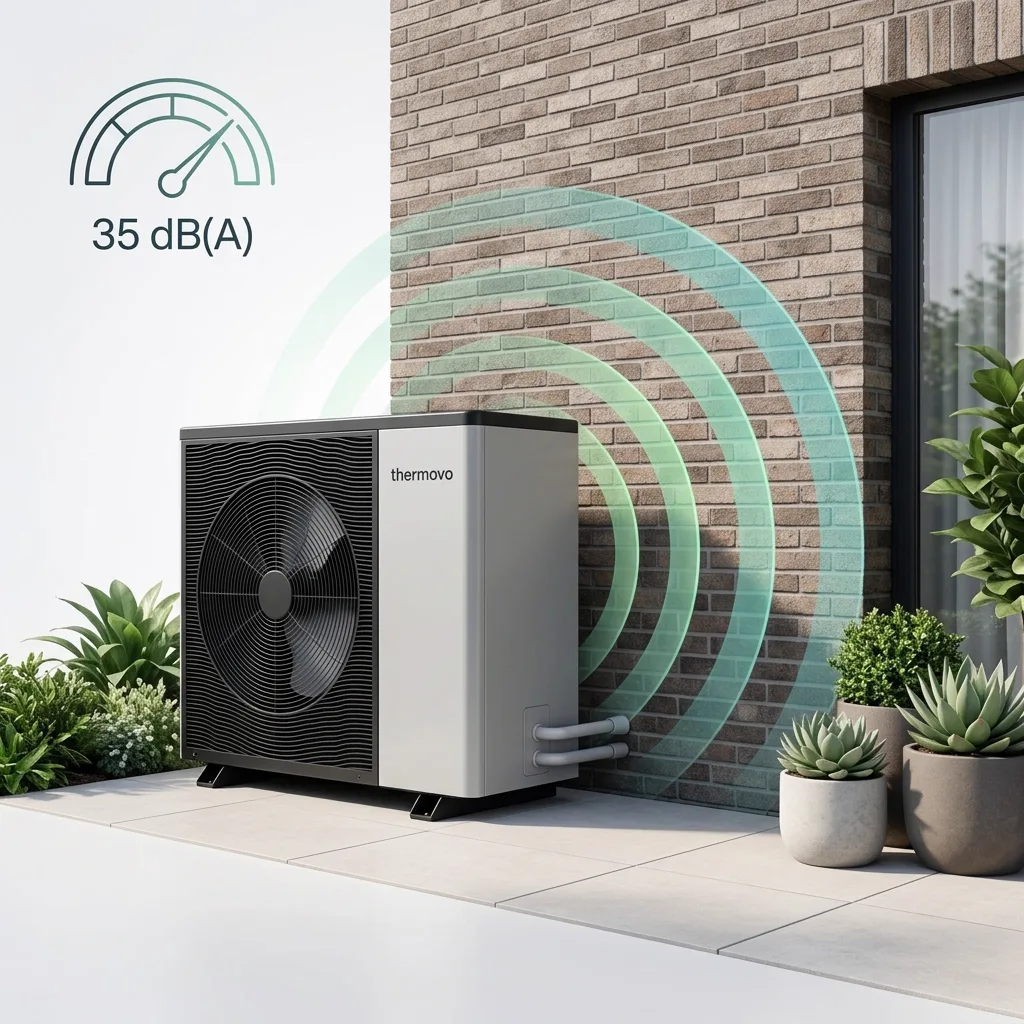
  • Scenario A (Q = 2, distance 4m): L_p = 55 - 20 * log10(4) - 8 ≈ 35 dB(A)
  • Scenario B (Q = 4, distance 4m): L_p = 55 - 20 * log10(4) - 5 ≈ 38 dB(A)
  • Scenario C (Q = 8, distance 4m): L_p = 55 - 20 * log10(4) - 2 ≈ 41 dB(A)

Placement in a corner increases the noise level by 6 dB(A) compared to open space, which is equivalent to nearly quadrupling the acoustic energy.


2. 2026 Regulatory Limits in Europe

European countries have established strict regulatory limits to protect residents from low-frequency and continuous noise. The table below outlines the boundary limits for Germany, the Netherlands, and France:

CountryRegulation / StandardZone / Area TypeDay Limit (dB(A))Night Limit (dB(A))Measurement Reference
GermanyTA LärmPure Residential (Reines Wohngebiet)<br>General Residential (Allgemeines Wohngebiet)<br>Mixed Area (Mischgebiet)50<br>55<br>6035<br>40<br>45Measured 0.5 meters outside the window of the nearest affected residential room.
NetherlandsBouwbesluit / BblAll Residential Areas4540Measured at the property boundary (erfgrens) or at open windows/doors of neighbors.
FranceCode de la santé publiqueAll Residential Areas (Emergence Limits)Ambient + 5Ambient + 3Measured inside or outside the neighboring residence compared to background noise.

Germany: TA Lärm Detailed Requirements

The Technische Anleitung zum Schutz gegen Lärm (TA Lärm) mandates that at night (22:00 to 06:00), the noise level outside a neighbor's window in a pure residential area must not exceed 35 dB(A). Additionally, if the heat pump emits distinct pure tones (such as compressor hums or high-pitched fan whistles), a penalty of 3 to 6 dB(A) (Ton- und Impulszuschlag) is added to the measured value, making compliance even more challenging.

Netherlands: Bouwbesluit / Bbl Requirements

Since April 2021, and continuing into 2026, the Netherlands enforces a strict limit of 40 dB(A) at the property boundary (erfgrens) during the night (19:00 - 07:00). If the unit exceeds this limit, it must either be fitted with an acoustic enclosure, moved further away, or operated in a restricted low-noise night mode.

France: Global Emergence Limits

France does not use a fixed decibel limit but rather a relative metric called émergence globale (Article R1336-5 of the Code de la santé publique). The noise from the heat pump must not exceed the ambient background noise by more than 5 dB(A) during the day (07:00 - 22:00) and 3 dB(A) at night (22:00 - 07:00). In quiet suburban or rural areas where night-time background noise is 25 dB(A), a heat pump must not exceed 28 dB(A) at the receiver, which is a highly restrictive threshold.


3. Engineering & Installation Solutions

Achieving compliance and ensuring neighbor goodwill requires a combination of structural vibration isolation, airborne noise attenuation, and strategic physical placement.

A. Structure-Borne Noise: Vibration Isolation

Heat pump compressors generate low-frequency vibrations that can travel through the ground and into building walls, creating a low-frequency hum inside the house.

  • Massive Concrete Foundation: The outdoor unit should be anchored to a decoupled concrete foundation (mass of at least 150 kg) separated from the house walls by an expansion joint.
  • Anti-Vibration Mounts (Silent Blocks):
    • Rubber Dampers: Best for medium-to-high frequency vibrations.
    • Spring Dampers: Recommended for high-vibration systems or timber-frame buildings to absorb low-frequency compressor startups.
  • Flexible Hydraulic Connectors: Connect the heat pump to the indoor piping using flexible, stainless-steel braided armored hoses (min. 500mm length) rather than rigid copper or steel piping. This stops vibrations from propagating into the indoor radiator network.

B. Airborne Noise: Acoustic Hoods & Enclosures

For tight spaces or units located close to property boundaries, an acoustic hood is the most effective solution.

  • Labyrinth Airflow Design: Acoustic hoods must balance sound attenuation with airflow requirements. A labyrinth path forces sound waves to bounce off absorbing surfaces while allowing the fan to pull in enough fresh air to prevent thermal short-circuiting (which drastically lowers COP).
  • High-Density Damping Materials: Quality enclosures utilize open-cell polyurethane foam or heavy mineral wool lined with waterproof membranes to absorb sound waves, providing a reduction of 5 to 15 dB(A).

C. Placement and Distance Optimization

  • Avoid Reverberant Spaces: Never install a heat pump in a narrow driveway between two concrete walls or in a recess. The sound waves will reflect repeatedly, magnifying the noise level (reverberation).
  • Orientation: Direct the fan discharge away from neighboring properties. Fans are highly directional; sound pressure levels are up to 10 dB(A) lower behind the unit than directly in front of the fan discharge.
  • Ground Absorption: Place the unit over soft ground (lawn, mulch, flower beds) rather than concrete or paved patios. Soft surfaces absorb sound waves, whereas hard surfaces reflect them.

4. Frequently Asked Questions

Q: Where can I find the official noise level of my heat pump?
A: The certified Sound Power Level (L_w) is always printed on the European Energy Label of the heat pump. This is the value that installers use for official planning applications and noise propagation calculations.

Q: Does "Quiet Mode" or "Night Mode" reduce heating capacity?
A: Yes. Quiet mode works by electronically limiting the maximum speed of the compressor and the fan. This reduces noise by 3 to 6 dB(A) but typically reduces the heating capacity by 10% to 25%. Installers must ensure that the reduced capacity is still sufficient to heat the home on cold winter nights.

Q: Can plants or hedges block heat pump noise?
A: No. Hedges, shrubs, and trees provide excellent visual screening, but their acoustic attenuation is negligible (usually less than 1 dB(A)). To block sound waves, a barrier must have mass and be solid, such as a brick wall, a heavy timber acoustic fence, or a dedicated acoustic enclosure.

Q: What are the legal consequences of non-compliance?
A: If a neighbor complains and a measurement proves a violation of local limits (e.g., TA Lärm in Germany), local authorities can fine the owner, force the unit to be shut down during night hours, or issue a mandatory order to relocate the unit or install an expensive acoustic enclosure.