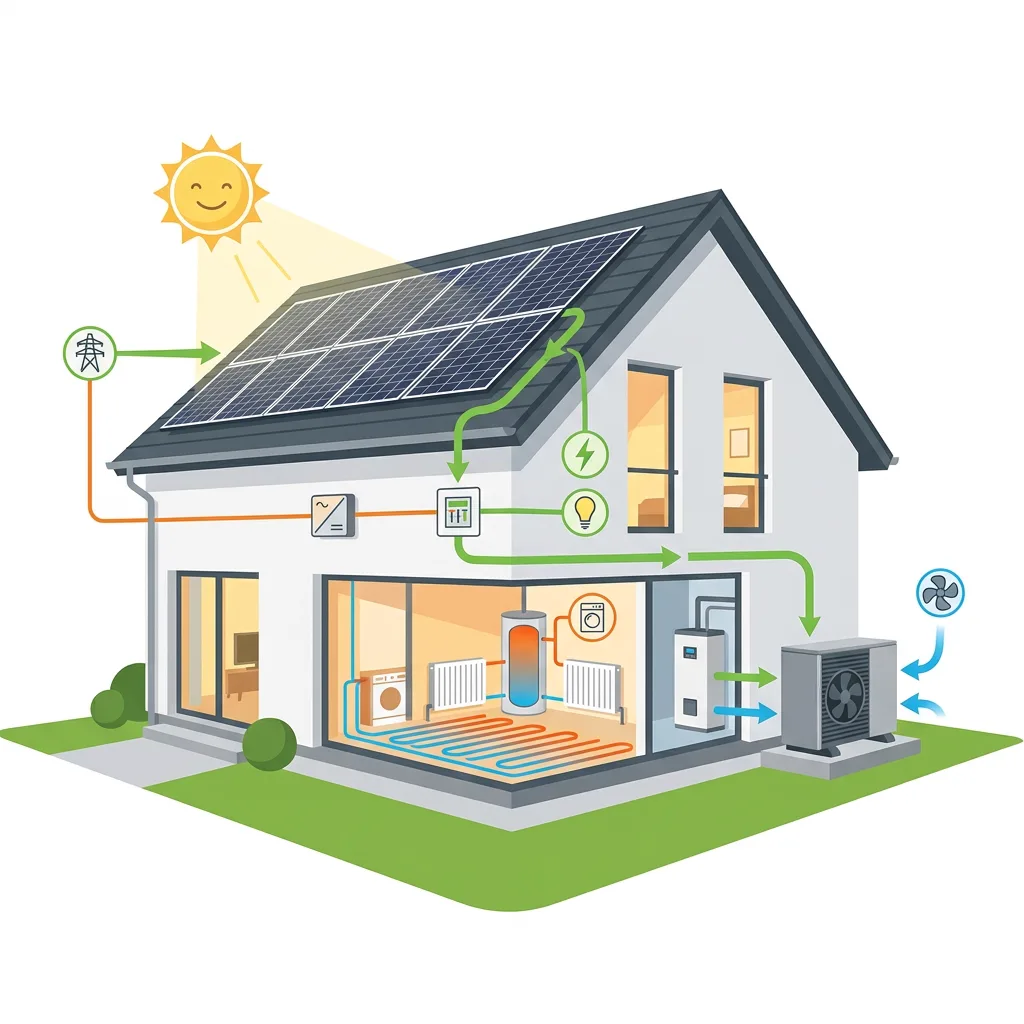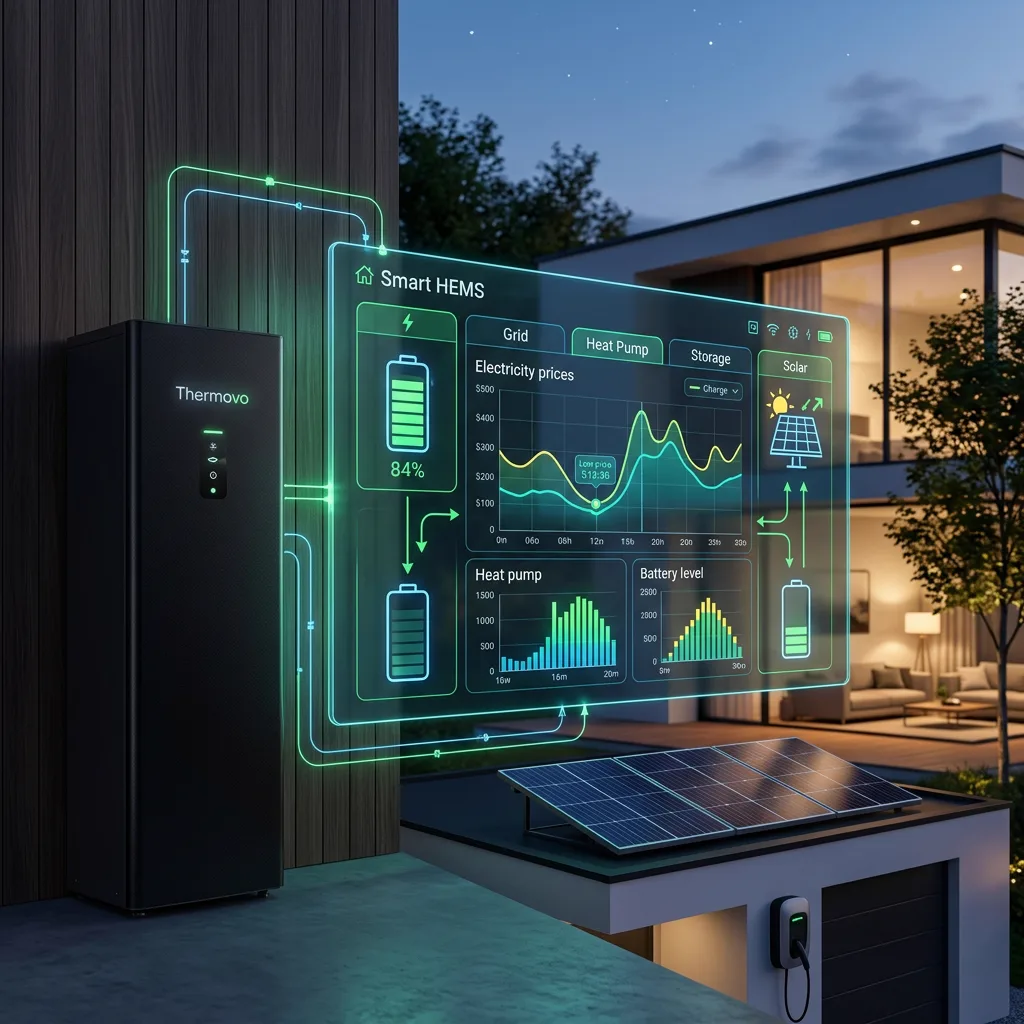
In 2026, air-to-water heat pumps are no longer isolated heating appliances running on basic outdoor weather compensation curves. The emergence of dynamic hourly electricity tariffs (such as EPEX SPOT and Nord Pool), rapid adoption of residential solar PV systems, and home battery storage have made Smart Home Energy Management Systems (HEMS) the central brain of residential energy efficiency.
By integrating your heat pump with a HEMS, you can automatically shift your system's electrical consumption to hours when electricity is cheapest—or even negatively priced—while charging thermal buffer tanks and underfloor heating mass to store heat for peak price hours.
This technical guide explores HEMS control architectures, integration protocols (SG Ready vs Modbus TCP vs EEBUS), predictive AI algorithms, and practical setup strategies to maximize financial savings and grid independence.
1. System Architecture: The Smart Home Energy Ecosystem
A modern HEMS acts as a central conductor, continuously collecting real-time data from multiple sources to make optimal control decisions for the heat pump, solar inverter, battery, and EV charger.
Loading diagram...
2. Integration Protocols Matrix: SG Ready vs. Modbus & EEBUS
Connecting a heat pump to a HEMS can be accomplished via simple hardware relay contacts or sophisticated digital data buses. The table below compares the four dominant integration standards in 2026:
| Protocol / Standard | Communication Type | Control Precision | Bi-Directional Data | Main Features & Operational Capability | HEMS Recommendation |
|---|---|---|---|---|---|
| SG Ready (Smart Grid) | Hardware relay / Dry contacts (2-bit) | Stepped (4 discrete operating states) | No (One-way command) | Switches heat pump between Blocked, Normal, PV Surplus (Target +5K), and Forced Max | Good Baseline: Universal support across all heat pump brands |
| Modbus TCP / RTU | Digital serial / Ethernet bus | Continuous (0% to 100% stepless modulation) | Yes (Full sensor telemetry: temperatures, COP, kW) | Direct control over compressor frequency, target flow temp, pump speed, and fault diagnostics | Professional Standard: Maximum optimization precision |
| EEBUS | IP-based digital standard (Ethernet/Wi-Fi) | Continuous stepless modulation | Yes (Standardized data model) | Interoperable European standard for grid demand response and dynamic load balancing | Future-Proof: Excellent for grid operator integration |
| OpenADR / Matter | Cloud / Local Smart Home API | Variable | Yes | Enables automated participation in Virtual Power Plants (VPP) and smart home ecosystems | Expanding: Great for smart home automation |
3. Core HEMS Optimization Strategies
Strategy 1: Dynamic Spot Price Arbitrage
With dynamic electricity tariffs, hourly spot market prices fluctuate based on grid demand and renewable generation.
- Cheap / Negative Price Hours: During mid-day solar abundance or high overnight wind generation, electricity prices drop significantly (sometimes below €0.00/kWh). The HEMS signals the heat pump to operate at maximum efficiency, raising the Domestic Hot Water (DHW) tank to 65°C and the heating buffer tank to 45°C.
- Peak Price Hours: During morning (07:00–09:00) and evening (17:00–20:00) grid peaks when prices spike, the HEMS curtails or turns off the heat pump compressor. The home draws heat passively from the stored thermal water buffers and underfloor concrete thermal mass without consuming high-cost grid electricity.
Strategy 2: Solar PV Surplus Modulation
Instead of exporting excess solar energy back to the grid for diminishing feed-in tariffs, HEMS uses stepless Modbus TCP modulation to match the heat pump's electrical draw precisely to real-time PV surplus:
- If PV surplus is 1.2 kW, HEMS modulates the compressor to draw exactly 1.2 kW.
- If a cloud passes and surplus drops to 600 W, the compressor throttles down instantly, preventing battery drain or grid imports.
Strategy 3: AI Predictive Weather & Thermal Decay Modeling
Advanced HEMS platforms incorporate predictive machine learning algorithms:
- Solar Forecast Integration: If solar forecasting predicts clear sunny weather at 12:00, HEMS delays morning DHW heating until noon to run 100% on free solar power.
- Building Thermal Time Constant: HEMS models the thermal decay rate of the home (e.g., how fast indoor air drops by 1°C). It pre-heats the building prior to extreme cold fronts or high-tariff windows.
4. Practical Implementation Roadmap
- Select an Open HEMS Platform: Choose a HEMS compatible with your heat pump brand (e.g., Home Assistant, Loxone, EVCC, or manufacturer-native HEMS gateways).
- Install Dynamic Electricity Contract: Pair the system with a dynamic energy provider offering hourly EPEX SPOT prices.
- Establish Local Bus Connections: Prefer Modbus TCP (Ethernet) over wireless cloud APIs for zero-latency, local-only reliability.
- Configure Thermal Safety Margins: Ensure DHW legionella protection schedules are maintained and set maximum buffer flow temperatures to 65°C to protect heat pump compressors.
5. Frequently Asked Questions (FAQ)
Q: How much money can HEMS integration save compared to standard operation?
A: In combination with dynamic electricity tariffs and solar PV, HEMS integration reduces annual heat pump electricity operating costs by 25% to 45% compared to a standard weather-compensated installation.
Q: Is SG Ready sufficient, or should I use Modbus TCP?
A: SG Ready is great for simple binary triggers (e.g., boost when PV is available). However, Modbus TCP allows stepless power modulation and full temperature feedback, making it significantly more effective for dynamic price arbitrage.
Q: Does pre-heating the buffer tank reduce heat pump efficiency (COP)?
A: Operating at higher flow temperatures (e.g., 60°C instead of 45°C) slightly lowers COP. However, because the electricity used during dynamic low-price hours is 50% to 100% cheaper, the overall financial cost per kWh of heat delivered is substantially lower.
Q: What happens if the internet connection fails?
A: Quality HEMS systems operate locally over Modbus TCP or local APIs. If internet connectivity to price feeds drops, the heat pump controller automatically falls back to its internal weather-compensated heating curve.