R290 vs R32: Which Refrigerant Is Right for Your Heat Pump in 2026?
If you're researching heat pumps — whether for a new build, a renovation, or a commercial project — you've almost certainly encountered the R290 vs R32 debate. It's one of the most frequently discussed topics among installers, specifiers, and homeowners across Europe right now. And for good reason: the refrigerant inside your heat pump directly affects its efficiency, environmental footprint, long-term regulatory compliance, and even installation requirements.
In this guide, we'll break down everything you need to know about R290 and R32 refrigerants — from chemical properties to real-world performance — so you can make an informed decision.
Why Refrigerant Choice Matters More Than Ever
For decades, heat pump refrigerants were an afterthought for most buyers. But three major shifts have pushed refrigerant selection to the forefront:
- EU F-gas Regulation (EU 2024/573) — the latest phase of the F-gas regulation mandates a drastic reduction in HFC consumption, with a near-complete phase-out by 2050. Refrigerants with high Global Warming Potential (GWP) are being taxed and restricted.
- Energy prices — with electricity costs fluctuating across Europe, even small differences in seasonal efficiency translate into hundreds of euros per year.
- Building regulations — many countries now require minimum efficiency ratings (often A++ or A+++) for new installations to qualify for subsidies and incentives.
Your refrigerant choice touches all three.
What Is R32?
R32 (difluoromethane, CH₂F₂) is a single-component HFC refrigerant that has been the workhorse of the residential heat pump industry for the past decade. It replaced R410A as the industry standard because it offers:
- Lower GWP than R410A: 675 vs 2088 — a meaningful improvement, though still significant
- Better efficiency: approximately 5-10% higher COP than equivalent R410A systems
- Lower charge: requires about 30% less refrigerant by weight
- Mild flammability (A2L): classified as "lower flammability" — burns slowly and requires a high ignition energy
R32 heat pumps are widely available, well-understood by installers, and have a proven track record across European climates from Scandinavia to the Mediterranean.
R32 at a Glance
| Property | Value |
|---|---|
| Chemical formula | CH₂F₂ |
| GWP (100-year) | 675 |
| Safety class | A2L (mildly flammable) |
| ODP (Ozone Depletion) | 0 |
| Typical charge (10 kW unit) | 1.5 - 2.5 kg |
| Global phase-down status | Under F-gas quota reduction |
What Is R290 (Propane)?
R290 is pure propane (C₃H₈) — a natural hydrocarbon refrigerant that has been used in commercial refrigeration for years and is now rapidly entering the residential and light commercial heat pump market. It represents a fundamentally different approach to refrigerant selection.
Key advantages:
- Ultra-low GWP of 3 — essentially negligible compared to any synthetic alternative
- Excellent thermodynamic properties — high latent heat, favorable pressure-temperature curve
- Higher achievable flow temperatures — can reach 70-75°C, making it ideal for radiator-based retrofit applications
- Future-proof — exempt from F-gas quotas, no phase-down concerns
- Natural substance — no PFAS (per- and polyfluoroalkyl substances), aligning with upcoming EU chemical regulations
The trade-off: R290 is classified as A3 (highly flammable), which imposes specific safety requirements on system design and installation.
R290 at a Glance
| Property | Value |
|---|---|
| Chemical formula | C₃H₈ |
| GWP (100-year) | 3 |
| Safety class | A3 (highly flammable) |
| ODP (Ozone Depletion) | 0 |
| Typical charge (10 kW unit) | 0.8 - 1.5 kg |
| Global phase-down status | No restrictions — natural refrigerant |
Head-to-Head Comparison
| Factor | R32 | R290 |
|---|---|---|
| GWP | 675 | 3 |
| F-gas quota | Yes — restricted | No — exempt |
| Max flow temperature | ~60°C | ~75°C |
| Efficiency (typical SCOP) | 4.0 - 4.7 | 4.2 - 5.0 |
| Safety class | A2L (mild) | A3 (flammable) |
| Charge size | Larger | Smaller |
| Installer familiarity | High | Growing rapidly |
| Retrofit suitability | Good (low-temp) | Excellent (high-temp) |
| Cost (unit) | Lower | Slightly higher |
| PFAS-free | No | Yes |
| Regulatory future | Phasing down | Unlimited |
Environmental Impact: Beyond GWP
While GWP dominates the conversation, it's not the whole story. A full lifecycle assessment considers:
Direct Emissions (Leakage)
If an R32 system leaks its full 2 kg charge, the CO₂ equivalent is 1,350 kg — roughly the same as driving 6,000 km in a diesel car. The same leak from an R290 system: 6 kg CO₂ equivalent. That's a 225x difference.
Indirect Emissions (Energy Consumption)
A heat pump's lifetime carbon footprint is dominated by the electricity it consumes — not its refrigerant. This is where R290's efficiency advantage matters. Even a 5% improvement in SCOP over 15 years saves more CO₂ than the entire refrigerant charge contains.
PFAS and "Forever Chemicals"
R32 belongs to the HFC family, which — while not PFAS itself — is under increasing regulatory scrutiny alongside PFAS under the EU's Chemicals Strategy for Sustainability. R290, as a pure hydrocarbon, contains no fluorine at all. For projects targeting BREEAM, LEED, or other green building certifications, this can be a decisive factor.
Safety: Understanding the Real Risks
The safety question is where most of the anxiety around R290 comes from. Let's address it directly.
R290 Is Flammable — and That's Manageable
Yes, propane is flammable. But so is the natural gas piped into millions of European homes for cooking and heating. Modern R290 heat pumps are engineered with multiple layers of safety:
- Sealed refrigerant circuits with leak detection sensors
- Minimum indoor unit volume requirements to ensure any potential leak stays well below the lower flammability limit (LFL)
- Automatic shut-off valves that isolate the refrigerant circuit if a leak is detected
- Manufacturing standards (IEC 60335-2-40) specifically updated for A3 refrigerants in heat pumps
In practice, millions of R290 heat pumps and refrigerators are already operating safely across Europe. The key is proper installation by a trained professional — the same as with any gas appliance.
Indoor vs Outdoor Installation
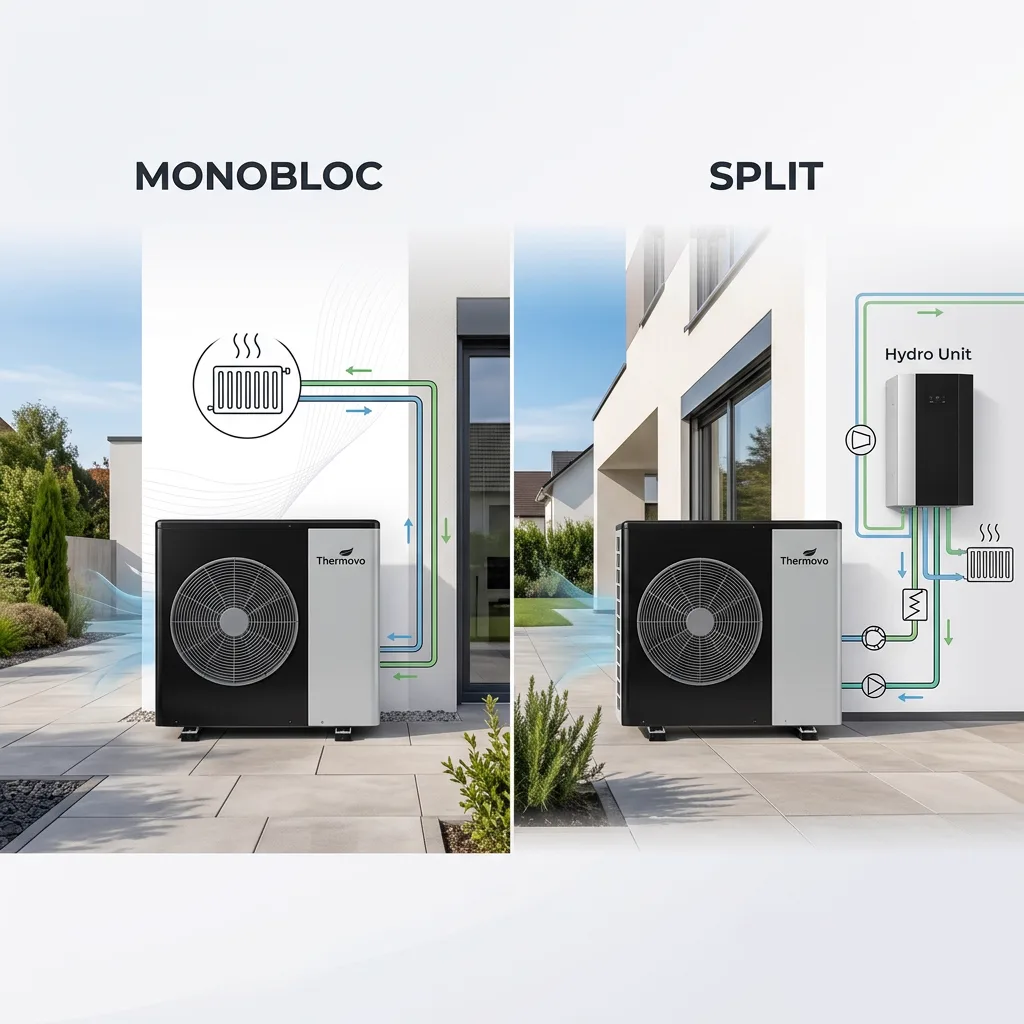
The main safety consideration with R290 is indoor installation, where minimum room volumes apply. For monobloc systems (where the entire refrigerant circuit is outdoors), this is essentially a non-issue — which is why most European R290 heat pumps are monobloc designs.
The EU Regulatory Timeline
The regulatory landscape is the strongest argument for R290. Here's the trajectory:
| Year | Regulatory Event |
|---|---|
| 2025 | F-gas quota cut to ~30% of 2015 baseline; GWP >750 banned in self-contained AC/HP <12 kW |
| 2027 | Further quota reductions; GWP >150 restrictions expand to larger systems |
| 2030 | F-gas quota at ~20% of baseline; R32 still permitted but increasingly expensive |
| 2032-2035 | Proposed bans on GWP >750 in all split AC/HP systems |
| 2050 | Near-complete HFC phase-out under current trajectory |
The practical implication: R32 will remain available but will become progressively more expensive as quotas tighten. R290 faces no such constraints. For a heat pump installed today with a 15-20 year lifespan, the refrigerant's regulatory runway matters.
Performance in Real-World Conditions
Cold Climate Performance
Both R32 and R290 perform well in cold climates, but R290 has a slight edge at very low ambient temperatures due to its thermodynamic properties. At -15°C, a well-designed R290 system can still achieve a COP above 2.5, while equivalent R32 systems typically range from 2.0-2.3.
High Temperature Capability
This is where R290 really shines. The ability to deliver flow temperatures of 70-75°C without supplementary heating means R290 heat pumps can often replace a gas boiler in existing radiator systems without changing the radiators. R32 systems typically max out at 55-60°C — adequate for underfloor heating and oversized radiators, but potentially requiring upgrades in older properties.
Which Should You Choose?
Choose R32 If:
- Budget is the primary concern (R32 units are generally cheaper)
- You're installing in a new build with underfloor heating (low flow temps)
- Your installer is not yet trained on R290 systems
- You're comfortable with a technology that has a 10-15 year regulatory runway
Choose R290 If:
- You want the lowest possible environmental impact
- You need high flow temperatures for radiator-based retrofit
- You're concerned about long-term F-gas costs and availability
- Your project targets green building certifications
- You want a genuinely future-proof system
Thermovo's Approach
At Thermovo, we offer both R32 and R290 heat pump ranges because we believe in matching the right technology to each application. Our R290 monobloc series is designed specifically for the European retrofit market, delivering flow temperatures up to 75°C with SCOP ratings above 4.5. Our R32 split systems provide a cost-effective solution for new builds and low-temperature applications.
Both ranges meet or exceed ErP A+++ requirements and are backed by our full EU warranty and support network.
Frequently Asked Questions
Q: Is R290 being phased out like R32? No. R290 is a natural refrigerant with near-zero GWP. It is explicitly exempt from F-gas regulations and faces no phase-down.
Q: Can I replace an old R410A heat pump with an R290 unit? Yes. Our R290 monobloc units are designed for direct retrofit into existing heating systems, including those with radiators.
Q: Are R290 heat pumps more expensive? The unit cost is typically 10-15% higher than an equivalent R32 model, but lower installation complexity (monobloc design) can offset much of this difference. Long-term, the absence of F-gas taxes and higher efficiency deliver lower total cost of ownership.
Q: Do I need special training to install R290 heat pumps? Yes. Installers need A3 refrigerant handling certification. However, for monobloc systems (where the refrigerant circuit is factory-sealed), the installation process is similar to any outdoor unit.
Q: What happens if an R290 heat pump leaks? Modern R290 systems have leak detection sensors that trigger automatic shutdown and isolation. Because the charge size is small (typically under 1.5 kg) and outdoor units dissipate quickly, the risk is minimal when properly installed.
This article is for informational purposes. Always consult a qualified heating engineer for specific installation advice.